
US President Donald Trump and Israeli Prime Minister Benjamin Netanyahu had a tense phone call over the future course of the war on Iran, with Washington favouring a deal instead of resuming strikes, according to US media reports.
A senior Pakistani minister has admitted that the country failed to capitalize on the China-Pakistan Economic Corridor (CPEC), citing attempts by the previous government to undermine Chinese investments, leading to investor flight.
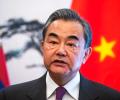
The Ministry of External Affairs (MEA) said China and other countries have no locus standi to comment on Jammu and Kashmir and they should note that India refrains from public judgment of their internal issues, in what is seen as a strong reaction and message to Beijing.

'Pakistan's is the only military-controlled nuclear weapons programme in the world.' 'As people get radicalised, the risk of a brigadier or pilot taking matters into their own hands is a real concern.'

Dar recalled that when he met US Secretary of State Marco Rubio in July and asked about dialogue with India, the top US diplomat clarified that India has maintained it is a "bilateral issue."

Direct talks between the US and Iran, mediated by Pakistan, have failed to produce an agreement after 21 hours of negotiations, with disagreements over Iran's nuclear ambitions and sanctions proving insurmountable.

Pakistan Foreign Minister Shah Mahmood Qureshi will begin a four-day official visit to India on Friday to carry forward the peace process between the two countries and address outstanding issues like Kashmir.

The Strait of Hormuz crisis is impacting lifestyles worldwide, from reduced gold purchases in India to energy conservation in Europe and Japan, as governments urge citizens to adapt to the global energy shock.
Pakistan has backed China's claim that Beijing played a role in defusing tension with India during Operation Sindoor, calling it 'diplomacy for peace' that was part of international efforts.

External Affairs Minister S Jaishankar conveyed a strong message to his Polish counterpart Radoslaw Sikorski regarding terrorism and the Ukraine conflict, emphasizing the need for zero-tolerance towards terrorism and criticizing the selective targeting of India.

Amid rising tensions between Pakistan and Afghanistan, President Trump voices strong support for Pakistan, praising its leadership and overall performance.

Through his commitment to democratic norms, debate, dissent and constitutionalism, Jawaharlal Nehru helped ensure that parliamentary democracy took deep root in independent India. Utkarsh Mishra evaluates Nehru's 17 years as India's first prime minister, examining his role in nation-building, democratic institution-building, economic planning, scientific advancement and foreign policy.

A source familiar with US Treasury Secretary Scott Bessent's thinking revealed on Saturday that the department "intends to utilise all available authorities to make Iranian assets accessible for rebuilding and repair efforts related to any future damage inflicted by Iran."

External Affairs Minister S Jaishankar raised India's concerns with US Secretary of State Marco Rubio regarding changes to US visa and immigration policies, emphasising that legal mobility should not be negatively affected. Rubio acknowledged potential 'bumps' during the transition as the US aims to improve its immigration system.

Iran's foreign ministry spokesperson Esmaeil Baqaei on Sunday said that the recent meeting with US officials was the longest round of negotiations they have had in the past year.

Pakistan hockey captain Shakeel Ammad Butt has criticized the national federation following a problematic tour of Australia, citing issues with accommodation and team management.
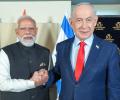
The Congress party has criticised the Indian government's diplomatic strategy, claiming a 'severe setback' if reports of Pakistan mediating between the US-Israel and Iran are accurate. The party alleges Pakistan's diplomatic engagement has surpassed India's, despite military successes.

In a significant diplomatic manoeuvre aimed at de-escalating regional tensions, Iran has reportedly submitted a "new proposal" to the United States through Pakistani intermediaries.

Iranian foreign ministry spokesperson Esmaeil Baghaei said that the country has held no "direct" talks with the United States as of now and added that it has received messages through some mediators regarding the US' desire for negotiations.

Chaffing under public ridicule in the US as well as internationally for having 'lost' the war, Trump is under immense pressure to do something, cautions Ambassador M K Bhadrakumar.

'We were in a heavily nuclearised environment. China had tested for Pakistan in the 1980s and helped their missile programme stay just one step behind us.'

The US Navy seized an Iranian-flagged cargo ship in the Gulf of Oman, escalating tensions as ceasefire talks face uncertainty. The incident raises concerns about the fragile ceasefire and the ongoing blockade of the Strait of Hormuz.
Khurshid Mehmud Kasuri said the US secretary of state appreciated Pakistan's help in securing peace and stability in Afghanistan.

US President Donald Trump has indefinitely extended the ceasefire with Iran at the request of Pakistan, aiming to allow Tehran's leadership time to form a unified proposal to end the seven-week war.

A senior Pakistani official has affirmed Pakistan's commitment to supporting Saudi Arabia, even before assistance is explicitly requested, amidst ongoing conflict in West Asia. This pledge underscores the close ties between the two nations and Pakistan's role in regional stability.
Seeking foreign loan had forced Pakistan to 'bow' its head and make compromises at the 'cost of self-respect', Prime Minister Shehbaz Sharif has said in a candid admission about the humiliation involved in approaching 'friendly countries' for financial aid.
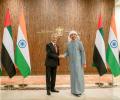
Frankly, was it really necessary in the middle of a fratricidal war for External Affairs Minister S Jaishankar to travel to Abu Dhabi for a one-on-one with the sheikh on April 12?Or, for National Security Advisor Ajit Doval to follow up on April 26? Or, for PM Narendra Modi to follow through today? There are no easy answers, notes Ambassador M K Bhadrakumar.
Pakistani Prime Minister Shehbaz Sharif is actively engaged in diplomatic efforts to de-escalate tensions in West Asia, offering to host talks between the US and Iran and engaging with regional leaders to promote peace and stability.
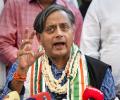
Congress MP Shashi Tharoor has approached the Delhi High Court seeking a ban on AI-generated deepfake videos that purportedly show him praising Pakistan. The court has issued summons to social media platforms and the Centre, indicating it may pass an interim order in Tharoor's favour.

US President Donald Trump's call to Prime Minister Narendra Modi signals a concerted effort to reset strained Washington-New Delhi ties, with a focus on 'big-ticket' energy and trade deals, including increased Indian imports of US LNG and LPG, and potential cooperation on small modular reactors.

West Bengal Chief Minister Suvendu Adhikari has announced a new border security initiative, including land transfer to the BSF and a 'detect, delete and deport' policy targeting infiltrators.

Trump seems to have estimated that Ghalibaf is a pragmatic politician who is receptive to close relations with the US and is enthusiastic about fostering business and economic ties in particular, points out Ambassador M K Bhadrakumar.
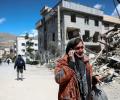
Fleur Hassan-Nahoum, special envoy, foreign ministry of Israel, has asserted that the situation has effectively been a "multi-front regional conflict" since its inception, while claiming significant military and strategic gains against adversarial forces.
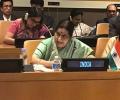
MEA spokesperson Raveesh Kumar said at a media briefing that the meeting, however, does not indicate any change in India's policy towards Pakistan.

Qureshi said External Affairs Minister Sushma Swaraj sent a letter on Sunday to congratulate Prime Minister Imran Khan and mentioned about talks to resolve issues.

Pakistan launched a retaliatory operation, 'Ghazab lil Haq,' against the Afghan Taliban following alleged border attacks, resulting in reported casualties and destruction of Taliban infrastructure.

Iran has announced the Strait of Hormuz is open to commercial vessels, coinciding with a ceasefire between Lebanon and Israel.
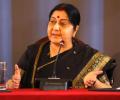
"Let me explain to you that we were not trapped by your 'googlies'. Our two Sikh Ministers went to Kartarpur Sahib to offer prayers in the Holy Gurudwara", she said.
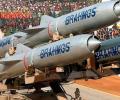
The foreign ministers of the Organisation of Islamic Cooperation have supported Pakistan's call for a joint probe to accurately establish the facts surrounding the accidental firing of a projectile into the country from India earlier this month.
